Talking to Myself in Public |

|
|
I made a simple little YouTube ad for my book. In theory, I have a wider reach on YouTube than on any other platform, because I have 3.45K subscribers, mostly thanks to one music video I posted in 2015 that has over two million views. In practice, this video has gotten six views in six days. Yay, I love being me. But I'm also friends with a host of a Star Wars podcast, and I arranged to exploit that for some free advertising under the rationale that my book drew lots of inspiration from Star Wars. I listened to this episode on mute because I want to support my friend but I'd rather slit my wrists than hear my own voice. This was my first time being interviewed about what I hope to leverage into a career, and I think I did pretty well right until the end. I've decided that from now on I'm not going to be apologetic or self-deprecating about the fact that I self-published. That was my choice, and I stand by it. I don't know how much rejection I would have experienced or how many changes the publisher would have wanted to make if I'd gone the traditional route, but the fact that I didn't is not a reflection on the quality of my writing. Also, at the end, I should have mentioned my Goodreads author page. I only mentioned my Amazon page and this website and said that should about cover it. My mind was racing with all my different social media profiles, and I thought I should keep it simple by not including them, and then I didn't mention the Goodreads author page because I haven't done anything with it, I have one follower (the podcast friend), and I don't have a strategy for using it to further my career. I should, though. But see, I'm learning already, and it's a very good sign that I don't hate everything about this interview. A few days later, as it happens, another friend sought out people to participate in a podcast that she's making for a college class. The topic is "life lessons you wish you had learned sooner." I'm not sure if I'll do it or not, because the biggest life lesson I wish I had learned sooner, besides the generic and boring ones, is one that she, a Mormon, wouldn't want to hear. The biggest life lesson I wish I had learned sooner is this: Feelings are not a reliable method of evaluating truth. I've only learned this in the last couple of years. My parents and everyone in the LDS Church taught me from a young age to base my worldview in large part on "spiritual witnesses" that are actually just normal human emotions. As an adult, I thought I was so open-minded and well-rounded because I accepted spiritual methods of evaluating certain kinds of truth in addition to empirical methods for evaluating other kinds of truth. But this sandy foundation, and my desperate wholehearted efforts to follow God's direction for my life, eventually brought me a world of pain and disillusionment. Pleasant feelings are not the Holy Ghost. Unpleasant feelings are not Satan. This is so obvious now. I'm pretty pissed off that I was indoctrinated to think that way. I try not to be pissed off at any specific person who indoctrinated me, because I know they all meant well. There was a very specific point in my life, age seventeen, where I chose to continue believing the church, despite all the evidence I'd stumbled upon that Joseph Smith was a fraud, because of the powerful "spiritual witness" I'd felt at EFY. It's hard to say I regret that as such. I don't regret moving to Utah, going to USU, or meeting many wonderful people and having many great experiences through the church. It's impossible to even say how my life would have turned out otherwise. But eventually, my fidelity to this decision - to God, I thought - drove me to twist myself into intellectual pretzels, put up with a lot of bullcrap that was so clearly wrong, and waste several years of my life defending and promoting a lie. I wish I had still come to Utah and gone to USU but left the LDS Church years earlier. And I hope to help others figure it out sooner than I did before they base their major life decisions on unreliable feelings, perhaps with less positive results. Think of all the women who gave up their dreams because their prophet told them to be stay-at-home moms, for example. Think of all the irrational things people may do because they think the Holy Ghost told them to. Someone posted this on reddit a few months ago. They filed it under Humor/Memes, but it's not funny, it's terrifying that children are being groomed to think this way. Or more precisely, to not think at all. 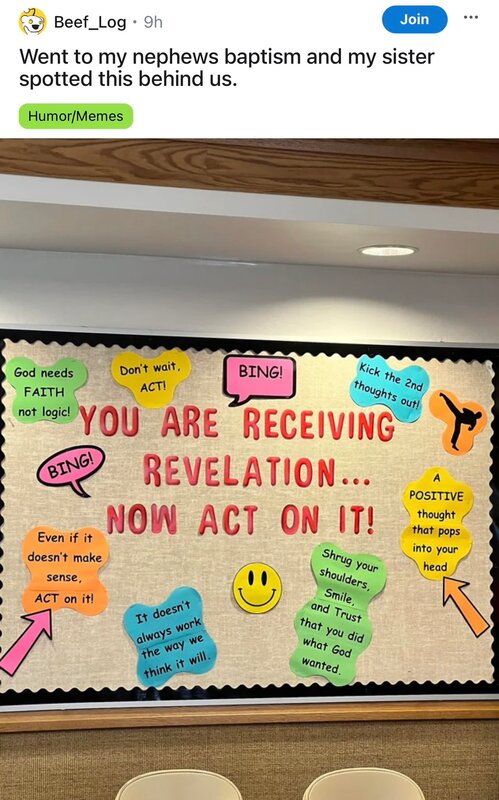 People in every religion appear to get the same "spiritual witnesses" that the LDS Church wants to monopolize, and I point this out at every opportunity. Mormons typically give me one of two responses. The first one is that of course all these people feel the Holy Ghost because all religions have some truth. But that still undermines the claim that Mormons' spiritual witnesses specifically prove that their religion is the most true. Mormons have no right to assert that their subjective personal feelings are more powerful or more authentic than everyone else's subjective personal feelings. This also fails to explain why "the Holy Ghost" bears witness of the truth of suicide cults, as attested by people who have been filmed bearing emotional testimonies a few days before they killed themselves because their prophet told them to. And when I bring that up, Mormons give their other response, which is that Satan deceived those people by mimicking the Holy Ghost - something that the LDS Church specifically taught me he couldn't do. My sister said that's why we have to evaluate religions by their fruits. I tried to explain that nobody in the world sees the LDS Church protecting child abusers or lying about its obscene wealth and thinks "Ah, this must be the true religion." Someone posted this on reddit a few days ago. I can vouch that nothing in it is inaccurate. I was taught all of this in the LDS Church, and now, from the other side, the manipulation and circular reasoning are so obvious (without even getting into the fallacious claim that the church is automatically true if the Book of Mormon is true). 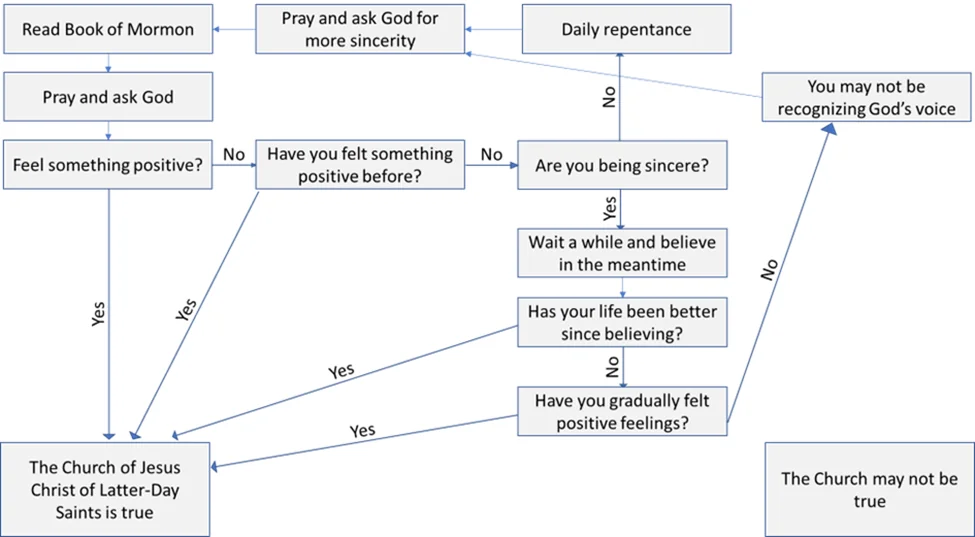 The LDS Church quite noticeably pulls this same bullcrap with tithing. If you pay it and good things happen, that proves tithing is a true principle and you should keep paying it. If you pay it and good things don't happen, that means you need to wait on the Lord's timing or you're just failing to notice the subtle ways he's blessing you, and tithing is still a true principle and you should keep paying it. There is no scenario in which the church will concede that the tithing promise has been falsified. While I'm on the subject of the Book of Mormon, though, I want to address a couple of faith-promoting cliches that I saw all over Twitter when Mormons began studying it in their church curriculum this year. The people saying these things weren't the usual alt-right jerks that I interact with, so I left them alone unless they specifically invited feedback. But I can't stand the claim that Joseph Smith only had 85 days to translate the Book of Mormon and therefore it was miraculous. According to his own narrative, he had five and a half years between the time he first mentioned the golden plates and the time he started translating them. His mother later wrote of this period, "During our evening conversations, Joseph would occasionally give us some of the most amusing recitals that could be imagined. He would describe the ancient inhabitants of this continent, their dress, mode of travelings, and the animals upon which they rode; their cities, their buildings, with every particular; their mode of warfare; and also their religious worship. This he would do with as much ease, seemingly, as if he had spent his whole life among them." He even got a bit of a practice run when he dictated the original 116 pages and then didn't reproduce them after Martin Harris lost them, as he would have been able to do if he'd actually received them by revelation. And then he only needed to dictate for three to six hours a day to get the Book of Mormon finished in 85 days. Suddenly it's a little less miraculous. I also saw a lot of assertions that the Book of Mormon has "held up to scrutiny" for almost two hundred years. That one just baffles me. Orthodox Mormons will continue to believe in it because of their "spiritual witness," not because of external evidence or internal consistency, regardless of what anyone says. Meanwhile, the people outside of the LDS Church and the tiny Mormon splinter groups who take it seriously as an ancient document can be counted on one hand. Virtually all scholars of anything regard it as an obvious work of nineteenth-century fiction. Even many Mormons regard it as a work of nineteenth-century fiction. I have no real idea, but I think it would be generous to estimate that 0.05% of people in the world believe the Book of Mormon is what Joseph Smith said it was. So why does that tiny fraction of a percent, whatever it happens to be exactly, get to decide that the book has "held up to scrutiny"? What does that even mean under these circumstances? Just that the book has continued to exist? That's a pretty low bar, and not miraculous by any stretch of the imagination. It's the same bar to which they hold the entire LDS Church now that its "miraculous" growth rate has been plummeting for three decades in a row. 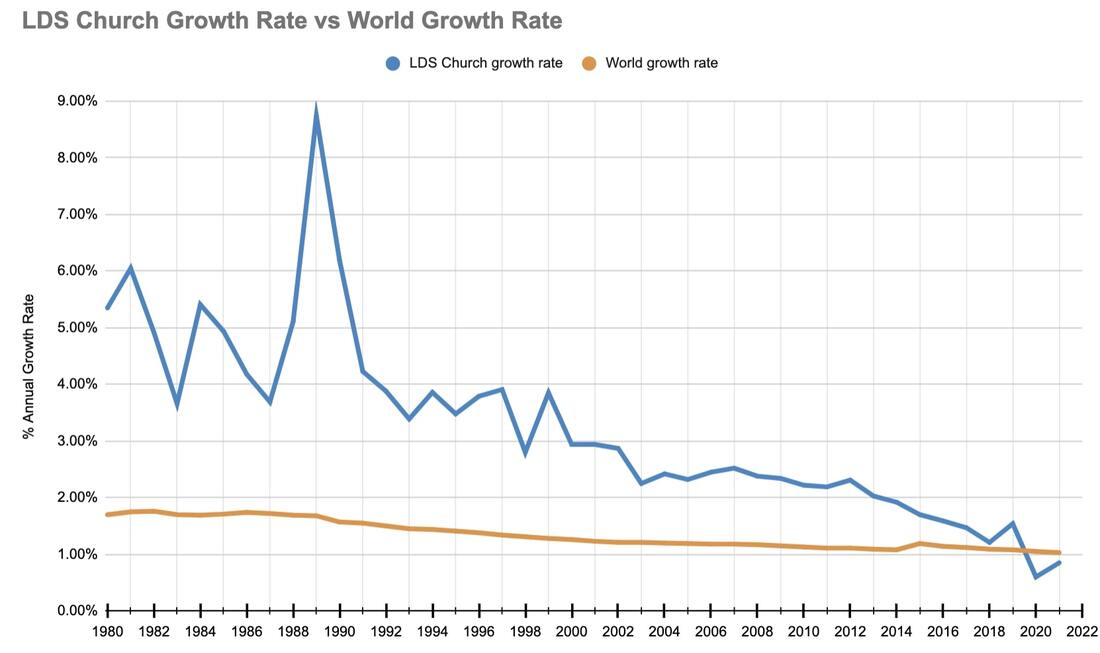 So that's why I'm not sure if I'll appear on this other friend's podcast.
0 Comments
If God is all good and all loving, it must be pure constant agony for him to restrain himself from snapping his fingers and erasing men like Vladimir Putin and Ali Khamenei from the face of the Earth. I'm neither all good nor all loving but I wouldn't be able to restrain myself for a millisecond if I had that kind of power. It drives me out of my fucking mind to be powerless while these demons on the other side of the world are destroying millions of lives with impunity. I don't deny, of course, that God may have perfectly valid reasons for not stopping them, like agency and whatever, but I certainly can't be expected to believe this is the same being who struck people dead for touching the Ark of the Covenant and turned them into pillars of salt for I don't even know why. I'm not ready to give up on God yet. I hope all the people who have given up their lives so other people can have basic human rights someday have gone home to him, and I hope he's treating them really well to compensate for having been oppressed, tortured, raped, beaten into comas, etc. I hope they didn't just cease to exist when they were murdered by Russian soldiers or Islamic terrorists. Reminder that by installing the Snowflake browser extension, you can help Iranian revolutionaries and other oppressed people circumvent government censorship. Here are some pictures I found on r/NewIran that I think are superior to whatever impotent words I might otherwise churn out. I like this one because it works on multiple levels. I hope the artist doesn't get murdered.  These girls' regime-sucking parents made them do this PR stunt that very few people in the world are stupid enough to buy...
First I think this one is beautiful, and then I think I must be really sick for thinking that. It's not beautiful that these women had their eyes shot out by Islamic terrorists for demanding basic human rights to which they are entitled by birth, but their indomitable spirits really show in this picture. And those indomitable spirits are why the Islamic Republic is boned. I just wish I could be a part of that, damn it.  Then I saw this last night. I don't know much about Iranian politics except that the Islamic Republic is a blister on Satan's testicles, but Reza Pahlavi is the Crown Prince who would be in charge right now if the Islamic Republic hadn't come to power, and he's emerging as a de facto figurehead for the current revolution. Of course not all Iranian revolutionaries like or support him but the general consensus is that they should send Khamenei back to hell now and worry about their differences later. Anyway, I don't know if any rallies or marches will happen in Logan, Utah, which has few Iranian expatriates, but I will certainly participate if I become aware of any. I considered stepping way out of my comfort zone and trying to start some but I don't think that's my place and I don't think it would be any more successful than my previous attempts to make a difference in the world. 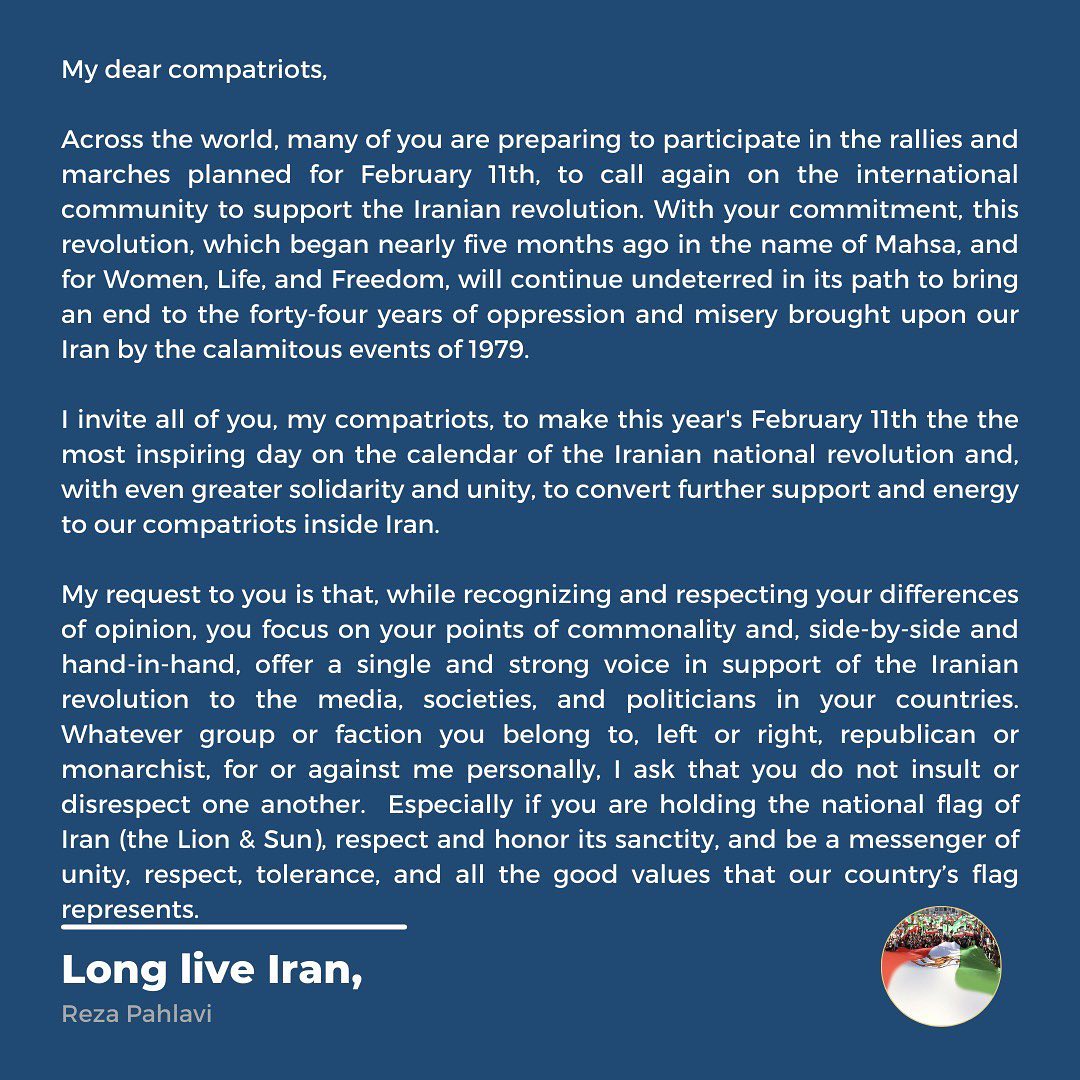 ...because it's impossible to hide the truth.  I stopped following r/latterdaysaints on reddit after I was banned for encouraging critical thinking and intellectual honesty. I was legitimately trying to help; I'm not such a jerk that I'll go into people's safe spaces for the purpose of tearing down their beliefs. For example, in a discussion about young people's loss of trust in institutions such as the LDS Church, I explained the real reasons for young people's loss of trust in institutions such as the LDS Church. One would think that anybody who wants to address a problem would want to understand the real reasons for it instead of a straw man. But no. So now I'm done trying to help and I'll just content myself with watching the church shoot itself in the foot over and over and over and over and over and over and over again. But the other day someone in another subreddit shared a screenshot of part of a post in r/latterdaysaints and I was going to write a post here explaining why it was wrong, but then I went and read the whole thing and several of the comments and I decided to just copy-paste them here and add my commentary in bold. u/onewattWhat is an "Anti-Doctrine?"Anti-Doctrine is my term for a doctrine or teaching that is said to be part of our shared beliefs only by those who do not believe. "anti-doctrine" then, has a double meaning because it refers to both the opposite of doctrine - something that we do not teach instead of something we do teach - and it also refers to its use by "anti-Mormons" [emphasis in original] Common usage by antagonists to faith These anti-doctrines are often presented as "What your religion REALLY teaches" or as some sort of secret that was covered up and never revealed to you, the unsuspecting believer. (insert snarky tone How kind of the non-believer, then, to reveal what you were secretly believing all along!) How to recognize Anti-Doctrine Because the word "doctrine" just means "teachings," anything taught by church members in any positions of authority could be called "doctrine." This can create confusion and, indeed, openings for antagonists to use to attack our faith. However, Elder Neil L Anderson guides us with a better standard for finding out what The Church really teaches: There is an important principle that governs the doctrine of the Church. The doctrine is taught by all 15 members of the First Presidency and Quorum of the Twelve. It is not hidden in an obscure paragraph of one talk. True principles are taught frequently and by many. Therefore, long-ago statements by church leaders, no matter how important they were, may not qualify as a doctrine of our faith if those statements haven't survived to be taught today by our leaders. In other words, "what the church really believes" is what it teaches in public today, what the majority of members actually believe, and what we practice. It's not the random thoughts, speculation, or interpretation of cherry-picked statements from other flawed humans - even when those words are found in scripture! It's certainly not the ill-willed proclamations of antagonists who want to extend the words or actions of an individual to be indicative of our entire belief system. A Few Examples of Anti-Doctrine
The list goes on. Anybody trying to tell you what "Mormons Really Believe" is making an effort to load more and more into your "Truth Cart" so it's easier for them to tip it over. There is no standard, consistent, accepted definition for what constitutes "doctrine" in the LDS Church, which is why nobodies on reddit have to go into long-winded explanations like this. (I don't mean to insult OP by calling them a nobody, but simply to differentiate them from the men in leadership positions whom one might think would be the proper source of such explanations.) The challenge is to craft a definition that includes all the parts that the current prophets and apostles teach but not the parts that past prophets and apostles taught that the church would rather forget about. Members commonly say doctrine is the stuff that never changes, which is useless circular logic because we don't know what's going to change until it changes. And this whole exercise is a pet peeve of mind because the word "doctrine" just means "teachings." I was surprised and impressed by OP's intellectual honesty in pointing that out. I was going to argue that most of these things used to be doctrine by any reasonable definition even if they aren't anymore, but I actually don't think OP would dispute that. I also like their acknowledgment that some things aren't true even if they're found in scripture, though I certainly was never taught that level of nuance in any church setting and had to get it from Ben Spackman's blog instead. I would agree that most of LDS Church's doctrine, unlike its history and finances, was never hidden from me. But there was the small matter of women covenanting in the temple to obey their husbands. When a friend from high school asked me about that, I had no idea what she was talking about, but I believed my church's doctrine that men and women were equal, so I told her it wasn't true and didn't give it another thought until January 2019 when the media reported on the removal of that part of the temple ceremonies. It felt like a punch in the stomach. In addition to dozens of statements by church leaders for over a century that certainly exceed any threshold of being "random" or "cherry-picked," the "skin color is a sign of a curse" thing is canonized in the Book of Mormon and the Pearl of Great Price. (What a strange coincidence that this teaching isn't in the Bible but it is in two books produced by Joseph Smith.) I was in my freshman year of college before I recognized how racist it is to believe that God gave the wicked Lamanites a "skin of blackness" to dissuade the "white and delightsome" Nephites from marrying them. In the last couple decades or so apologists have argued that this skin color change should be read metaphorically, but that certainly isn't what generations of (white) leaders taught and even now I doubt it's what the majority of (white) members believe. So okay, OP did say "even if those words are found in scripture." Fair enough. But this "anti-doctrine" has a more authoritative basis than the others on their list. I will comment on some other items from the list as opportunities present themselves. u/ihearttoskateI was taught approximately a third of these as a convert, by several sources and leaders, and they were presented as doctrine. I understand my experience is not universal, but it is frustrating when members tell me I should have known they weren't "doctrine". This is the top comment and I appreciate it. u/Fourme34I'm a recent convert (less than 6 months) and I've been taught a few of these things and yes they have been taught to me as doctrine, so I'm confused by this post. This is a reply to the top comment and I appreciate it. u/OmniCrushCan you list which ones you were taught? I also think this is tricky because the actual answer may be a variation of some of the statements given. This is another reply to the top comment and I appreciate it. u/ihearttoskateSure, and agreed, sometimes it's a variation.
I was taught as a kid that I would get to create planets, by a guest speaker at a youth activity who joked that he would create a planet full of ski resorts. He never said I would be limited to just one. Then as an adult the church came out with an essay claiming that "Latter-day Saints’ doctrine of exaltation is often similarly reduced in media to a cartoonish image of people receiving their own planets" and "few Latter-day Saints would identify with caricatures of having their own planet." So even as a believing member that was kind of annoying. Just last week I found this quote on its website by accident while reading about aliens: "Nothing is more basic in the restored gospel than these truths that, because of recent events of space travel, are so timely. The great hope of the gospel for us is that we may come to a oneness with our Lord and our Father and partake of this same work and glory and godhood. Being joint-heirs of all that the Father has, we may then look forward to using those powers to organize still other worlds from the unorganized matter that exists throughout boundless space. Creating other worlds, peopling them with our own eternal posterity, providing a savior for them, and making known to them the saving principles of the eternal gospel, that they may have the same experiences we are now having and be exalted with us in their turn—this is eternal life. No wonder this possibility continues to fascinate and inspire Saints of all ages. This hope is what inspires members of the Church to seek eternal marriage and to seek in all things to be one with our Lord Jesus Christ, because we want to be with him and participate in all the marvelous things of which Paul the apostle said: 'Eye hath not seen, nor ear heard, neither have entered into the heart of man, the things which God hath prepared for them that love him.' Pretending for the sake of argument that this is the only quote about exalted Latter-day Saints creating worlds (which it isn't), we could say that it's a prime example of "anti-doctrine" because it's just an assistant BYU professor writing in the church's youth magazine. But we would still be well-advised to ask why the church approved it for publication and where he even got the idea that "nothing is more basic in the restored gospel" than this "great hope of the gospel for us" which "continues to fascinate and inspire Saints of all ages." Or do we just need to split hairs about the difference between creating a world and receiving a planet? I had an institute teacher who said that Black people's skin color was caused by the "curse of Cain" as recently as 2015. The Come Follow Me manual for 2020 included this quote: "The dark skin was placed upon the Lamanites so that they could be distinguished from the Nephites and to keep the two peoples from mixing [see 2 Nephi 5:21-23; Alma 3:6-10]. The dark skin was the sign of the curse. The curse was the withdrawal of the Spirit of the Lord [see 2 Nephi 5:20]. . . . Dark skin . . . is no longer to be considered a sign of the curse” (Joseph Fielding Smith, Answers to Gospel Questions, comp. Joseph Fielding Smith Jr. [1960], 3:122-23)." After an uproar from Black members, it was replaced with something entirely different in the digital version. Setting aside the fact that they edited this quote to completely misrepresent what Joseph Fielding Smith actually wrote (hint: it was more racist), it's kind of bonkers that the manual writers apparently didn't think it would offend anyone because it says that dark skin isn't a sign of a curse anymore. They're in their own little world sometimes. I am surprised people are still being taught that polygamy is required for the highest level of celestial glory. I've heard members offer their opinion that we'll all have to practice it because a lot fewer men will be in the celestial kingdom, but nobody asserted it as a given. On the contrary, I was blessed with institute teachers who assured us that it isn't true just because Brigham Young taught it. u/is_that_a_titlistThis is confusing to me (as a lifelong member). I have heard many variations of the “polygamy is required for salvation” conversation. If polygamy ISNT important, than why is it canonized in D&C? I grew up being told polygamy would be happening in the celestial kingdom, and that has become something I’ve grown to include in my belief system. [...] Well for me, due to the lack of comment from current leaders, I chose to follow past teachings & scripture and believe that polygamy will be a huge part of the celestial kingdom. I think too many members are saying, “polygamy won’t be required” simply because they don’t want it to be. But again, past teachings and scripture seem to tell it in a much more black and white way. I’m happy to be proved wrong, but that’s just how I accept polygamy in the church. It would be difficult to overstate the centrality of polygamy to LDS doctrine in the nineteenth century. The prophets and lay members of that era would unequivocally reject the church's current stance that the Lord's standard is monogamy and he only commands exceptions on rare occasions. For example, in August 1862 the Deseret News reported Brigham Young preaching, "Monogamy, or restrictions by law to one wife, is no part of the economy of heaven among men. Such a system was commenced by the founders of the Roman empire…. The scarcity of women gave existance [sic] to laws restricting one wife to one man. Rome became the mistress of the world, and introduced this order of monogamy wherever her sway was acknowledged. Thus this monogamic order of marriage, so esteemed by modern Christians as a holy sacrament and divine institution, is nothing but a system established by a set of robbers…. Why do we believe in and practice polygamy? Because the Lord introduced it to his servants in a revelation given to Joseph Smith, and the Lord’s servants have always practiced it. 'And is that religion popular in heaven?' it is the only popular religion there..." This wasn't the first or last time he denounced traditional marriage. But I'm sure the current prophet is entirely trustworthy on that subject.  u/DaikonNo7Interesting post. One issue is when those points still correspond to scripture in canon still I don’t think it can be classified as “Anti”. Like D&C 107:53 which says adam lived in the valley of Adam ondi Ahman which is in Missouri and can be found on the church website: “Spring Hill was named Adam-ondi-Ahman by the Prophet Joseph Smith, as indicated by the Lord in revelation (see Doctrine and Covenants 116). Five weeks later, on June 28, 1838, the third stake of Zion was organized there. An 1835 revelation identified the valley of Adam-ondi-Ahman as the place where Adam blessed his posterity after leaving the Garden of Eden (see Doctrine and Covenants 107:53–57).” https://www.churchofjesuschrist.org/learn/historic-sites/missouri/adam-ondi-ahman?lang=eng Leaders don’t really talk about this anymore but it’s still there. So what do we do with it? [...] The issue isn’t the garden it’s that Adam the first man lived in Missouri when the rest of the Bible narrative was in the Middle East. When did he get over? You have believe in the literal flood to get them over there or some other migration and a lot of people want to believe that’s metaphorical or regional but it doesn’t work if Adam lives in Missouri. Next if there was a flood when did the native Americans from Asia get over to this land and how did they get here if not for the Bering straight? It makes sense if the Book of Mormon is the story of all the descendants but science puts the Asian migration at 15 thousands plus years ago. Joseph Smith caused a lot of problems for his church by doubling down on the literal historicity of people who didn't exist and events that didn't happen. Adam and Eve, Noah's flood, and the Tower of Babel are all myths and were understood as such by the people who wrote them down. Joseph Smith misunderstood them through his nineteenth-century American worldview and codified his misunderstanding as doctrine. Many members today take more nuanced views of them, but the other three books in the LDS scriptural canon (and some other supposedly prophetic teachings) fall apart if they aren't literal history. No Tower of Babel = no Jaredites. u/Appropriate_Way_787Well shoot if I was there thousands of years ago, I could tell ya. Stories from the old testament have been passed down over thousands of years surely with details forgotten and others exaggerated. To be honest, in the bigger picture, it doesn't matter whether or not the garden of Eden was in Missouri or not. It has no bearing on our eternal salvation, and is likely why 'leaders don't talk about it anymore'. Even as a member I hated when other members fell back on "That's not important to my salvation" as a way to avoid thinking about legitimate questions or issues. How many hours a day do you spend on things that aren't important to your salvation? u/MizDianaDo you consider (up-to-date) instructions in the church handbook to be doctrine? As a transgender person, I know some members who have rejected handbook instructions regarding trans people as being church teachings/doctrine (both to claim the church is more welcoming or less welcoming to trans folk, in fact). Though to be fair, I think in most cases they simply refused to believe I was telling them the truth about what's in the handbook. I just thought it was cool that a transgender person was participating in this thread. I bet fifty thousand dollars they'll be out of the church within five years. u/onewattIf "doctrine" means "teaching," then there really is no separation between policy and doctrine. Handbook instructions, letters from the first presidency, and the like might all be considered doctrines. But we must not put too much weight on the word "doctrine." Too many people treat that word like it means "eternally true forever and perfect" when it still just means "our current understanding" Elder Maxwell used to speak about this occasionally, suggesting that there is clearly an as-of-yet unrevealed hierarchy of truths, ranging from the "true but unimportant" to the "true and of eternal significance." To say "the handbook is doctrine" doesn't really solve anything unless the person saying it and the person hearing it have the same understanding of what the word doctrine means. Here, OP rejects the useless circular logic definition that annoys me so much, and I appreciate it. I also agree that the supposed distinction between policy and doctrine is pretty pointless. Supposedly they both come from the Lord. u/Ebenezar_McCoySome of these things were certainly fringe ideas, but others were accepted beliefs taught and understood by most of the church at one point or another. Fringe:
Once widely accepted:
Questionable:
Between 1967 and 1978, a churchwide policy (as opposed to a fringe idea) based on the First Presidency's interpretation of scripture (as opposed to, oh I don't know, revelation or something) prohibited women from praying in meetings at all. It seems the church was "inspired" to remove this policy by ERA activist Sonia Johnson, who wrote in her memoir, "Apparently what happened was that my testimony before the Senate subcommittee - in which I quoted church leaders' affirmation of the 'exalted role of woman in our society,' and pointed out that they considered women too 'exalted' to offer prayers in sacrament meetings - began circulating immediately and widely underground in Utah, alerting many Mormons for the first time that women had been officially cut off from such prayers for a long time.... Most Mormon women, accustomed to having so few rights in the church, had not even noticed, and besides, not allowing women to pray in sacrament meeting had been well on its way to becoming standard practice in many localities of the church before the directive.... "One woman in Provo, Utah, read the testimony and vowed that she would not sing in church until prayer privileges were restored, because 'the song of the righteous is a prayer unto God.' Several faculty members at Brigham Young University were shocked into action and demanded an accounting from church headquarters. In the end, so much hue and cry was raised that President Kimball was forced to admit that the policy was not in accord with scripture and could not stand..." u/devilsravioliI’m sorry if this comes off wrong, but I have to be blunt concerning the quote from Elder Neil Anderson. It has bothered me since he said it at General Conference. His definition of ‘doctrine’ is not straightforward. Theoretically, in order for his definition of ‘doctrine’ to be taken seriously, all members of the Q15 need to repeat this teaching, right? But which Q15? Is it all living 15 at one time? Is it all 15 over a certain period? What if 14 have repeated the teaching, and the remaining one passes away? Do we hope the next one continues the tradition? Does everyone need to start over then? Are we all supposed to carry little notebooks with running tallies of who taught which doctrines when hoping we reach BINGO on our score card? Is this how we identify God’s doctrines? What do we have to hold onto that has been revealed by all members of the Q15? This list has got to be short and I would love it if anyone who has done the work tracking the individual teachings of all members of the Q15 to share it with me. I am more inclined to follow the well established definition of ‘doctrine’ in our theology: a teaching conveyed by a member of the Q15 (prophet, seer, and revelator, witness of the name of Christ, whether in public or private, in the right context). Yes, this definition provides a litany of contradictions and forces us to conform nuance, but we are at least left with some doctrine to interpret. The ‘doctrine’ described by Elder Anderson leaves us nothing to hold onto. It's especially silly when you consider how many LDS beliefs are based on one or two verses of scripture. u/onewattMistakes are a certainty. Science has shown over and over again that our politics are a greater predictor of our moral stance than our religion, and that's pretty obvious. Tell me you're a "Christian" and I know less about your view on some moral issues than if you tell me you're a staunch Republican or Democrat. By implication, then, we can't rely on our own ideas of "church" or "doctrine" to keep us grounded. We will tend to either read our own philosophy into the scriptures (like when one person in my ward started blabbering about how capitalism is at the heart of the Proclamation on the Family) or we will have thoughts like "that's not doctrine, it's policy" or "that's just his opinion, not speaking as a prophet" or "They're just a local leader, not a general authority," or "the prophet made a mistake." Our political and ideological bubbles are so thick sometimes that we are actually unable to recognize when we're the ones drifting on the wind. Has the world drifted to the right or the left, or have we? Has the church changed, or is it us? Our psychology, in a self-defense overdrive, tries to protect us from "being wrong" by making it impossible for us to consciously see what the truth may be. As social pressures shape various churches and believers, we have something to anchor ourselves to: Prophets. Our prophets, speaking as a united quorum of diverse backgrounds and political leanings, can become an anchor during perilous times. Will they be wrong sometimes? it is a certainty. Will they be wrong less than you? Almost certainly. But most important, they will continue to hold the keys of salvation. I've been wrong about many things, but I try to keep an open mind so I can eventually realize when I'm wrong and change my beliefs. LDS prophets don't do that. Like, ever. They don't back down, they don't retract, they don't apologize. Therefore I consider myself a much more reliable spiritual guide for myself than they are. The current prophet and his wife have doubled down on perpetuating the falsehood that he speaks for the Lord every time he opens his mouth, and even though members are allowed to say "prophets aren't infallible" in an abstract sense, they're told that they can't pick and choose which of the church's teachings to follow, and they're told that if they ever receive personal revelation that the church is wrong about something, their personal revelation is wrong because the church said so. Members who argued against the priesthood and temple ban on Black people before 1978 were wrong until suddenly they weren't. The lack of an honest and coherent solution to the serious problems of prophetic fallability was the final straw that drove me out. u/Atheist_BishopMy grandmother, one of the most faithful people I’ve ever known, very much believed that she was destined to make babies for eternity and she was not looking forward to it. She even wrote a poem about her dissatisfaction with the prospect of “eternal increase”. I’m not saying that means it is doctrine. But I am saying she did not get the idea from “anti-Mormons”. I'm sure this was an isolated anomaly, right? Right? u/Glittering_Page_4822I’ve been in the church 40 years and many of these were definitely taught as doctrine, even by Elder Anderson’s definition. I’ve been surprised that many now see some of them as ‘not doctrine’ Others, I agree we’re [sic] never doctrine, and other still, we’re [sic] definitely taught as doctrine, again, by elder anderson’s definition, but are no longer doctrine and in fact have been renounced by the church. Anti-doctrine definition may help you, and that is great, but clearly this has seemed to create significant confusion over what is really doctrine. Not much to add here, but "by the mouths of two or three witnesses" and all that. u/ForeverInQuicksandThere is a fairly clear precedent in the history of the church on how the church has made significant changes in doctrine. In 1835, Joseph Smith and the general assembly of the church voted unanimously to print the “Lectures on Faith,” in the Doctrine and Covenants, in order to provide a sure foundational doctrine of the Godhead. Almost 100 years later, in 1921, a council of leaders in the church felt the doctrine laid out in “Lectures on Faith” contradicted the then current acceptance of the teaching that man becomes like God, so with the new printing of the D&C, the lectures were removed. Today, it is rare to find someone in the church that is familiar with Joseph’s Lectures on Faith. I read the Lectures on Faith for the first time last year, having heard that they were really profound or something. They were okay, I guess. And yes, they do contradict current LDS doctrine, for example by asserting that the Godhead has only two members, the Father and the Son. u/MrsnateBy definition, doctrine is what is generally taught by a religion. Granted, most of these things are not acknowledged as “doctrine” today, but at one point many of them were taught. My parents, in their mid-70’s still believe we’re all going to have to trek to Missouri. When I told my mom that isn’t taught anymore, she couldn’t believe it! Growing up in the 80’s and 90’s a lot of these were taught to me. My sixty-something bishop in a YSA ward in a college town in 2021 had missed the memo that married women are allowed to have careers now. Kidding, there was no memo. u/ThinkThink23The idea that women will be eternal baby makers is unsupported. We have no evidence that pregnancy is required to make spiritual bodies. We have no idea what that process entails. Its a farce to claim mormons believe women will be eternally pregnant in the CK. I know firsthand that some mormons believe it and some don't. I had an institute teacher who asserted that this is the reason why men can be sealed to multiple women but not vice-versa. I've seen a guy claim that his wife looks forward to it. I agree that it's an absurd and disgusting belief, but it's a pretty logical extrapolation from the church's doctrine that physical bodies and heterosexual marriage are requirements for exaltation in the CK. That's not "no evidence." On the other hand, Brigham Young taught it, so that's pretty compelling evidence that it isn't true. u/onewattYeah that one drives me crazy as well. The ultimate, core doctrine of all our beliefs is, as best I can tell, "God is Love." If God loves his daughters perfectly, would he ever turn them into machinery or in any way seek to turn them from whatever path each of them wants to travel through the eternities? Would a celestial husband, seeking to be like Jesus Christ, be a part of making his other half a mechanism for fulfilling this insane idea of doctrine? It's literal nonsense that preys on fears and exploits our inability to understand what awaits us in the life to come. If the LDS Church's view of women is meant to be representative of God's view of women, they have good reason to be afraid. For most of its history it's treated them as little more than baby-making machines. The first quote that pops into my head is this gem from Spencer W. Kimball that was quietly deleted from the Eternal Marriage institute student manual last year: “Supreme happiness in marriage is governed considerably by a primary factor—that of the bearing and rearing of children. Too many young people set their minds, determining they will not marry or have children until they are more secure, until the military service period is over; until the college degree is secured; until the occupation is more well-defined; until the debts are paid; or until it is more convenient. They have forgotten that the first commandment is to ‘be fruitful, and multiply, and replenish the earth, and subdue it.’ (Genesis 1:28.) And so brides continue their employment and husbands encourage it, and contraceptives are used to prevent conception. Relatives and friends and even mothers sometimes encourage birth control for their young newlyweds. But the excuses are many, mostly weak. The wife is not robust; the family budget will not feed extra mouths; or the expense of the doctor, hospital, and other incidentals is too great; it will disturb social life; it would prevent two salaries; and so abnormal living prevents the birth of children. The Church cannot approve nor condone the measures which so greatly limit the family” (Teachings of Spencer W. Kimball, 328–29). Perhaps most pertinent is Doctrine and Covenants 132, the section of canonized scripture that coincidentally outlines both polygamy and exaltation as if they're somehow related, wherein the God of Love references women as objects that are given to and taken away from men as he sees fit. If he has the slightest concern for their agency or happiness, he chose a strange way to show it. Now of course, the scriptures themselves may contain anti-doctrines, but I'm not sure that can apply here seeing as this entire section is attributed to the Lord himself in the first person and wasn't even translated from another language. We'd better pray that Joseph Smith made it up. u/mywifemademegetthisAntagonists will do this intentionally. Many people may simply be misinformed and think they are true. I’m confident many of our members also share anti-doctrine about other faiths. It’s also difficult to say some of these things were never presented as “doctrine” but your point on frequency and recency is well-noted.
Yep, I've been in multiple Sunday school lessons where we mocked mainstream Christians for supposedly believing that God the Father and Jesus Christ are the same person and that Jesus prayed to himself. That's not how most of them understand the Trinity at all. In fact, as I've said before, I can't understand how three persons in one substance are significantly different from the LDS doctrine of the Godhead. The Book of Mormon states multiple times that there's one God, most Mormons would insist that they only believe in one God, and most Mormons would also say that Jesus is God just as much as Heavenly Father is God. But that's none of my business. I've had a reddit account since I don't know when, but until the last few weeks I only used it once in a great while to speak up when I saw something egregiously stupid, so I ended up with negative "karma" from people downvoting my comments. But I got into the positive a few weeks ago and, as the designers obviously intended, it gave me a bit of a dopamine rush. Haha, I thought, I hope I don't get addicted to this feeling. Of course I did. Anyway, the other day I saw that bestselling fantasy author and Latter-day Saint Brandon Sanderson had done an AMA (Ask Me Anything) and I was very impressed with his most popular response to the most popular question, so I'm going to pass it along here and save myself some actual writing for today. The question was asked by someone calling themself RattusRattus: How do you feel about the fact that queer people are treated better in your novels than on the campus you teach at? How do you reconcile donating to a church that promotes purity culture, homophobia, and anti-Semitism with writing books for the general public? BYU is pretty awful to queer people. In the 1960s and 70s it conducted witch hunts against closeted gay students with the object of forcing them to undergo conversion therapy (which didn't and doesn't work) or leave the school. A couple years ago it removed a ban on "homosexual behavior" from its Honor Code mid-semester, then for two weeks told confused gay students that yes, they were now allowed to date and hold hands and kiss just like straight students do, before the church commissioner of education who apparently had been asleep for two weeks told them that no, they still can't. Many students felt that they had been tricked into coming out of the closet. Hence the semi-regular protests since then. Ignorant people often ask why they go to BYU in the first place, and the answers include but are not limited to family pressure, the cheap tuition for members of the church that owns it, and the fact that people in their late teens and early twenties are often still figuring out their sexuality in the first place. An entire tax-exempt charity, the OUT Foundation, exists just to help LGBTQ+ students escape from BYU. So anyway, Brandon responded in a livestream that was subsequently transcribed thus: Thank you for a bold but not insulting phrasing of that question. So the church’s general stance on LGBTQ people is not where I, as a liberal member of the church, would like it to be. That being said, I have faith in the church, I have had spiritual experiences, confirming to me that this is where God wants me and that God is real. This gives me so much to think about. I've recently become even more convinced by the movie Lightyear that neutral or positive portrayals of LGBTQ+ characters in media are essential. I thought the movie was pretty mediocre, but these people having aneurysms because two women in it love each other can get bent. Disney has produced scores upon scores of movies where men and women kiss each other (or men kiss unconscious women, or whatever). One same-sex couple is not "forcing their lifestyle down your throat." It is not "grooming your children." It frightens me that some grown adults in this day and age still believe their children will turn gay if they ever see anyone being gay. For heaven's sake, see a therapist if you're that insecure in your sexuality. I grew up with heterosexuality constantly being shoved in my face by all the straight people who flaunt their lifestyles without a second thought, and I still thought sex was gross from the moment I learned what it was. What these media portrayals actually strive to accomplish is to demonstrate that LGBTQ+ people are just normal people with the same hopes and dreams as anyone else, thus reducing prejudice and making LGBTQ+ children (and adults) hate themselves less. No one can make me believe that isn't a worthy goal. As an aspiring author myself, obviously not worthy to even mention myself in the same post as Brandon Sanderson, I never had much of an agenda to do this. My as-yet-unpublished novel references the same-sex relationships of a couple of very minor characters for no other reason than to acknowledge that this is a fact of the world now and in 2153 when it takes place. Just recently when I revised it yet again, I realized that my protagonist is a little bit bisexual. She's mostly into men but she flirts with women just because she can. I never planned for her to flirt with women. I don't even know how to flirt with women. She just went ahead and did it. Similarly, in a story that I wrote for a graduate school class and then incorporated into my thesis, the protagonist and her best friend developed a camaraderie that seemed like a bit more than just best friends, and the professor pointed it out, so I went ahead and made them lovers and barely had to change anything. It was neither essential to the story nor agenda-driven. It just happened because the characters wanted it to happen. So maybe I'll just continue along those lines in my writing career if I ever have one. Brandon's response went over well. HandOfMaradonny said: I'm just super impressed you answered and didn't ignore. Brandon later responded directly to the original asker of the question: Honestly, I'm really glad you asked this one. Wow. Brandon Sanderson wants to wrestle with difficult ideas, difficult questions, and his own internal inconsistencies. A mind after my own heart. I think I'm in love. RIP Brandi WeaverI went to a small school where everyone in grades 7-12 knew everyone else's first and last name. When Kyle Cootware died in a four-wheeler accident in 2009, everyone mourned. A palpable gloom engulfed the entire school building. College hasn't been like that. Through the years I read in the news that a student I never heard of had died in a bike accident, and that a couple of students I recognized but never met had died by suicide, and that someone a couple blocks from my apartment had been murdered by her ex-boyfriend. But there wasn't the same sense of community and the same universal mourning. So anyway, I didn't know Brandi Weaver particularly well and I'm afraid I don't have a lot to say about her, but I did know her a little and it is a bit jarring and sobering that she's suddenly gone from natural causes at such a young age. I think I was in ninth grade when I sat at the same lunch table as her. It's been so long that I don't even remember, but I remember that she was always nice to me. She was one of those older girls who treated me like I was super cool even though I was the biggest dork. She smiled and joked a lot and just seemed to have a great attitude toward life. My condolences to her family and especially to her fiancé and children.  Her most recent Facebook profile picture The first real crack in my lifetime of "The Church of Jesus Christ of Latter-day Saints isn't sexist" conditioning came not from any critical source, but from the section on "Mothers' Employment Outside the Home" in the Eternal Marriage Student Manual. I was raised to believe that anything in the church that seems sexist to modern sensibilities is really just misunderstood. But after being in college for too long, some of these quotes that I'd probably already heard growing up really rubbed me the wrong way, and then this line in particular from Spencer W. Kimball jumped out as unequivocally, unapologetically, and undeniably sexist: "No career approaches in importance that of wife, homemaker, mother - cooking meals, washing dishes, making beds for one’s precious husband and children." Translation: Women have the most important divine role, which is to perform household chores for men and children. To be perfectly frank: barf. And from then on I couldn't stop seeing all the sexism that I'd been taught not to see. In February of last year I linked to this manual section in a blog post about how the church's teachings (aka doctrine) on women have evolved. Within a month, the entire section had quietly disappeared from the church's website. Coincidence? Probably, but you can't prove it. And that wasn't worth making a whole other post about, but yesterday a reddit post brought to my attention some more recent and more subtle deletions from the manual, and I just have to talk about them. Dating Standards Elder Spencer W. Kimball “Boys seldom criticize a girl for using too little makeup. Sometimes they say, ‘She’s a nice girl, but I wish she’d dress up, and she uses too much makeup.’ To be overdressed, to be gaudily dressed, to be dressed to look sexy, to be overdecorated is bad taste, to say the least. The young woman is smart who can don just enough powder and lipstick to convince the fellows it isn’t makeup at all, but the ‘real you.’... “Young men should keep their faces shaved, their hair combed, their haircuts reasonably conservative, their nails cleaned. Overtight, suggestive pants brand young men as vulgar. Young people can be smart and personable, dignified and attractive by finding an area somewhere less than the extremes and still in good style” (“Save the Youth of Zion,” Improvement Era, Sept. 1965, 761). 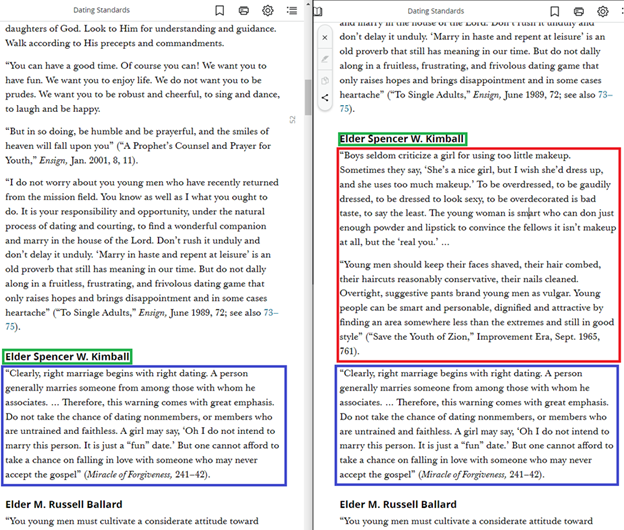 This quote is arguably a bit sexist - it reminds me of M. Russell Ballard's "Put on a little lipstick now and then and look a little charming" comment that may or may not have been blown out of proportion a few years ago - but it has the rare distinction of being more nitpicky about men's dress and grooming than women's, so I appreciate that. I assume it was just removed because dress and grooming standards have changed since 1965 (except at BYU) and it comes across as obnoxiously Pharasaical (like BYU). A lot of women like men with beards. Also, I know it's perfectly normal for women to wear just a little bit of makeup and for men to erroneously believe that they aren't wearing any, but Elder Kimball's phrasing here seems to encourage deception, so that's kind of funny. Women's Divine Roles and Responsibilities President Ezra Taft Benson “It is divinely ordained what a woman should do.... The divine work of women involves companionship, homemaking, and motherhood” (“In His Steps,” 64). “Brethren of the priesthood, I continue to emphasize the importance of mothers staying home to nurture, care for, and train their children in the principles of righteousness” (in Conference Report, Oct. 1987, 60; or Ensign, Nov. 1987, 49; see also To the Fathers in Israel, 3–4). See To the Mothers in Zion, on pages 352–57. “A mother’s role is also God-ordained. Mothers are to conceive, bear, nourish, love, and train. They are to be helpmates, and are to counsel with their husbands” (in Conference Report, Apr. 1984, 6; or Ensign, May 1984, 6). “It is divinely ordained what a woman should do, but a man must seek out his work. The divine work of women involves companionship, homemaking, and motherhood. It is well if skills in these three areas can first be learned in the parents’ home and then be supplemented at school if the need or desire presents itself” (“In His Steps,” 64). “There are voices in our midst which would attempt to convince you that these home-centered truths are not applicable to our present-day conditions. If you listen and heed, you will be lured away from your principal obligations. “Beguiling voices in the world cry out for ‘alternative life-styles’ for women. They maintain that some women are better suited for careers than for marriage and motherhood. “These individuals spread their discontent by the propaganda that there are more exciting and selffulfilling roles for women than homemaking. Some even have been bold to suggest that the Church move away from the ‘Mormon woman stereotype’ of homemaking and rearing children. They also say it is wise to limit your family so you can have more time for personal goals and self-fulfillment” (“The Honored Place of Woman,” Ensign, Nov. 1981, 105). 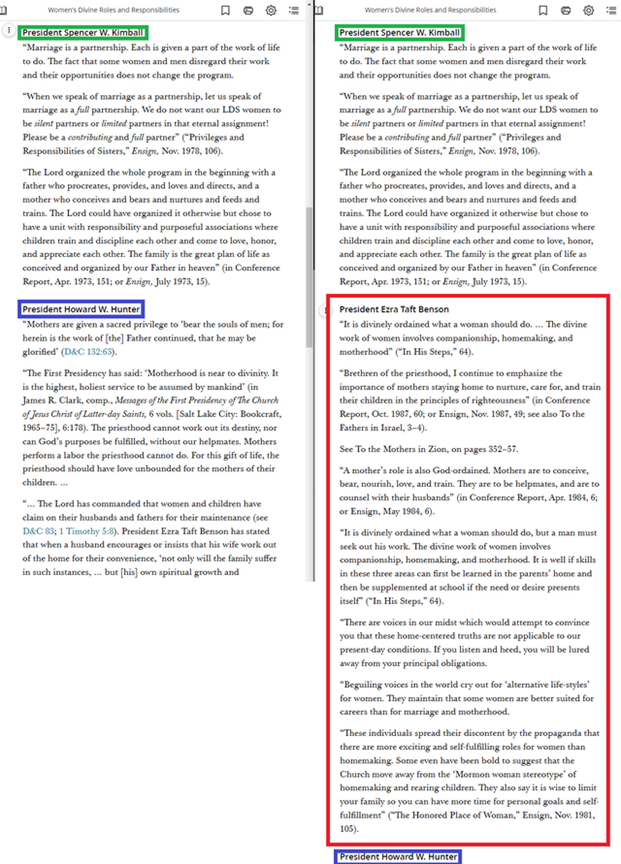 It's self-explanatory that this was removed for the same reason as the entire section on "Mothers' Employment Outside the Home." I'll just examine a few lines that stand out to me. "It is divinely ordained what a woman should do, but a man must seek out his work." Translation: women have a one-size-fits-all role, while men are free to seek out roles that fit their individual talents, interests, and personalities. They may, of course, still end up stuck in crappy jobs that they hate in order to support their families, but not for lack of trying. And this really gets at the heart of why "complementary" or "separate but equal" gender roles are not equal at all and never have been. "These individuals spread their discontent by the propaganda that there are more exciting and self-fulfilling roles for women than homemaking." Translation: if a woman doesn't feel sufficiently contented or fulfilled by menial household chores that her husband could just as easily do, she's been deceived by propaganda. She couldn't have possibly reached that conclusion on her own, and even if she did, she's not smart enough to know what's good for her. "Some even have been bold to suggest that the Church move away from the 'Mormon woman stereotype' of homemaking and rearing children." Please read this in Owen Lars' voice: Like the Church moved away from the 'Mormon woman stereotype' of homemaking and rearing children by showcasing career women in its "I'm a Mormon" ad campaign? Benson's anti-feminist masterwork speech referenced here, "To the Mothers in Zion," remains in the manual despite all these other deletions. That's a bit of an oversight, which I brought to someone's attention with the online feedback form in March. Birth Control President Spencer W. Kimball “Tomorrow when I repeat the phrases that will bind you for eternity, I shall say the same impressive words that the Lord said to that handsome youth and his lovely bride in the Garden of Eden: ‘Be fruitful and multiply and replenish the earth.’ ... “... You came to get for yourself a mortal body that could become perfected, immortalized, and you understood that you were to act in partnership with God in providing bodies for other spirits. . . . And so you will not postpone parenthood. There will be rationalists who will name to you numerous reasons for postponement. Of course, it will be harder to get your college degrees or your financial start with a family, but strength like yours will be undaunted in the face of difficult obstacles. Have your family as the Lord intended. Of course it is expensive, but you will find a way, and besides, it is often those children who grow up with responsibility and hardships who carry on the world’s work” (“John and Mary, Beginning Life Together,” New Era, June 1975, 8). “Supreme happiness in marriage is governed considerably by a primary factor—that of the bearing and rearing of children. Too many young people set their minds, determining they will not marry or have children until they are more secure, until the military service period is over; until the college degree is secured; until the occupation is more well-defined; until the debts are paid; or until it is more convenient. They have forgotten that the first commandment is to ‘be fruitful, and multiply, and replenish the earth, and subdue it.’ (Genesis 1:28.) And so brides continue their employment and husbands encourage it, and contraceptives are used to prevent conception. Relatives and friends and even mothers sometimes encourage birth control for their young newlyweds. But the excuses are many, mostly weak. The wife is not robust; the family budget will not feed extra mouths; or the expense of the doctor, hospital, and other incidentals is too great; it will disturb social life; it would prevent two salaries; and so abnormal living prevents the birth of children. The Church cannot approve nor condone the measures which so greatly limit the family” (Teachings of Spencer W. Kimball, 328–29). 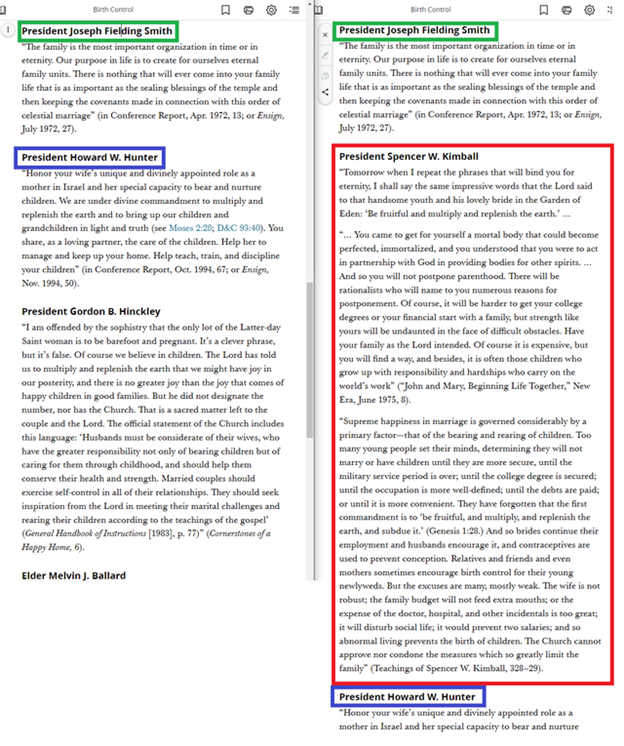 This section already omitted many quotes that straight-up denounce birth control as evil, because they don't jive with the church's current position that it's a personal decision. So Kimball's quote made the cut the first time around but now it crosses the line. Why? Probably because it pressures couples to have children that they can't afford or otherwise aren't ready to take care of, which is just plain terrible for everyone involved. I'm particularly disgusted that he, a man, considered "The wife is not robust" to be a "weak excuse" for not popping out as many babies as possible. This flat-out contradicts a far more reasonable David O. McKay quote on the preceding page: “In all this, however, the mother’s health should be guarded. In the realm of wifehood, the woman should reign supreme." (Then why does she need so many men to tell her how to do it?) Looking at this and the earlier deleted Kimball quote, though, I am impressed that the manual made a distinction between "Elder" Kimball and "President" Kimball. Usually when an apostle becomes president of the church, subsequent publications attribute all of his quotes to President So-and-So regardless of when he made them, which is lazy and misleading. Wayward Children Born Under the Covenant The Prophet Joseph Smith “When a seal is put upon the father and mother, it secures their posterity, so that they cannot be lost, but will be saved by virtue of the covenant of their father and mother” (in History of the Church, 5:530). 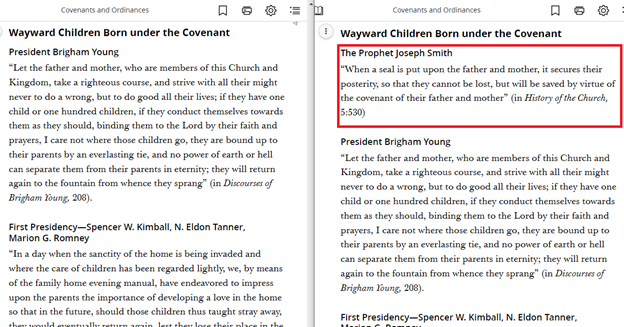 It's surprising to see anything from Joseph Smith deleted. He's had a better track record than most of his successors. And I don't know why this quote was problematic. I could see the church maybe wanting to move away from the implication that temple sealings remove children's agency, but the subsequent Brigham Young quote implies that far more strongly. Maybe the Joseph Smith quote encourages complacency by focusing on the ordinance (dead works) and not on the parents' actual efforts and worthiness? Maybe recent scholarship has cast doubt on its accuracy? That's all I've got.
Conclusion I'm grateful for these deletions, except for the last one, which I don't care about one way or another. I just wish the church actually announced or drew attention to them in some way. Yes, I realize it's awkward to explain why quotes from prophets, seers, and revelators are no longer acceptable for publication, but when the church just quietly discontinues old teachings without correcting or superseding them, people who were previously taught those things continue to teach them anyway. Case in point: last year, in a fifth Sunday lesson in a YSA ward in a college town, my sixty-something bishop was very adamant that God wants all women to be full-time homemakers, and told those present to only use their college educations to be better mothers, not to have careers, and that anyone who disagreed (like me) was deceived by the world's lies. Mostly I was pissed off and incredulous that he had failed to notice the shift in the church's position over the last thirty years, but I also felt a little sorry for him when I complained to the stake president (who agreed with me) about him teaching the same thing that the prophets taught when he was our age. With regard to this manual specifically, many institute teachers probably use a paper copy and will never notice the online revisions unless somebody tells them. But speaking of sexism, thanks to the recent states' rights free-for-all opened up by the repeal of Roe v. Wade, a ten-year-old rape victim from Ohio had to travel to Indiana to get an abortion. I hope God is warming up a spot in hell for every politician who thinks it's even an option to force a ten-year-old rape victim to endure pregancy and childbirth. (I argued with a family member who claims that pro-choicers don't care about her at all, that they're just using her as a pawn for their agenda to murder babies, as if liberals don't denounce rape literally all the time.) But I guess I can take some comfort in knowing that Utah, despite ranking as the second most sexist state in the nation and being a near-constant political embarrassment, will never be that bad... right? |
"Guys. Chris's blog is the stuff of legends. If you’re ever looking for a good read, check this out!"
- Amelia Whitlock "I don't know how well you know Christopher Randall Nicholson, but... he's trolling. You should read his blog. It's delightful." - David Young 

About the AuthorC. Randall Nicholson is a white cisgender Christian male, so you can hate him without guilt, but he's also autistic and asexual, so you can't, unless you're an anti-vaxxer, in which case the feeling is mutual. This blog is where he periodically rants about life, the universe, and/or everything. Archives
July 2024
Categories
All
|


 RSS Feed
