Talking to Myself in Public |

|
|
The bus that picked me up from Green Canyon High School was moving through the final crosswalk before the transit center, already late, when one of Utah's special drivers tried to turn in front of it and forced the driver to slam on the brakes, sending my phone through the air. I took the Lord's name in vain and extended my middle finger toward her, but she probably didn't notice. Then I went to pick up my phone, but it wasn't on the floor. It wasn't on a seat. It wasn't anywhere. The bus pulled in, everyone else got off, and I kept looking back and forth and over and under and behind with no success. I knew my phone was still on the bus because it was still broadcasting music into my headphones. I told the driver what had happened, and then to my surprise, a transit center employee came on and looked for it too. We were already late, and I knew the other passengers must hate me, and I couldn't blame them. But it wasn't my fault, it was that damn driver's fault. The employee said they'd have to look more thoroughly when the bus was out of commission.
I didn't want to leave without my phone, so I saw no alternative but to stay on for another loop. I tried really hard to take a Buddhist perspective and not be totally pissed off about this waste of my time. The smallest events change the courses of our lives in unpredictable and unknowable ways, so who's to say this waste of my time wouldn't save me from some horrible fate or expose me to some glorious opportunity? Of course, it could also have done the opposite of either of those things, but I tried not to think about that. The point was I didn't know, so I shouldn't be mad. I took the empty spot next to the one girl who had asked me what I was looking for while all the other passengers ignored me. By this point I had turned off my headphones. Maybe she would become my best friend, I thought. Maybe that was the silver lining here. I had the idea to ask if I could log into Google on her phone and use "Find My Phone" to make my phone make a noise even though it was on silent. It took me a while to build up the courage to make such a bold request, but I did, and she said yes. I put in my email and then her phone just spun a loading circle at me and did nothing. She said she'd just gotten it from her stepdad and it didn't work very well. She played with some settings and tried to fix it. She called her mom. I got up a couple of times to look for my phone again in the same places I had already looked four times. It's not like there were a bunch of nooks or crevices for it to be hiding in. The girl couldn't get her phone to work, but she said I could get off the bus with her and go to her apartment and try to track my phone from her laptop. I couldn't believe it. We were going to be friends! So I did that. Her apartment was surprisingly well-furnished and had two cats, one of whom took an instant liking to me. The girl said that meant I was special. I was okay with that as long as she didn't start saying stuff like she could read my aura and my heart was a nice color and she could see the future. She offered me water and said she was a bad host for not offering sooner. I said it was nice of her to invite me inside in the first place. She said she likes to help people, and if most people were as helpful as her, the world wouldn't be in the state that it's in. As you may have already guessed, I couldn't log in to Google on her computer because it required a verification code that it sent to my phone. There was literally no other way to do it. No security questions, nothing. She said I could report it as a theft to the police and they could help track it. I hoped it wouldn't come to that because I hate the police. I went back out to the bus stop in front of her apartment, and she asked if I wanted her to wait with me, and I said I didn't care, so she did. She asked about my life, and she said she wanted to go to USU, and that was when I figured out that, contrary to my assumption, she wasn't an adult. She still had a couple years of high school left. I now realized that we wouldn't be friends because it would be inappropriate for me to try to stay in touch in any way. Also, maybe she shouldn't have invited me into her apartment when her parents weren't home. But it's not like she was unfamiliar with stranger danger. When I said I didn't know my roommate before he moved in a couple of weeks ago, she said she hopes he's not a serial killer and doesn't murder me. Because the bus on this route was so far behind schedule, only partially because of me, another bus came through this time. I went to the original bus and asked the driver about my phone. Still nothing. He said maybe it was in the lost and found. I didn't have time to check right then because I took a detour to campus to turn in my city council ballot. I didn't vote for any incumbents because they all ignored my email of complaint about the police department. Then I walked home and opened "Find My Phone" on my laptop, where fortunately I was already logged into Google. At first it appeared that my phone had somehow fallen off by Mount Logan Middle School, just a few blocks away, even though we hadn't stopped there. But I refreshed the page and saw that, in fact, it was still traveling along the bus route. I took my laptop with me back to the transit center so I could use it to make my phone make noise as soon as the bus pulled in. I could do this because a few months ago, my neighbor didn't pay his power bill, and the WiFi went out, and he gave me access to xfinity WiFi hotspots. I was very curious to see where my phone had ended up and how the hell I had missed it over and over again. So the bus pulled in, I clicked the button, and I got on. Everyone missed or ignored the noise as they filed off, but as I headed toward the back of the bus it got louder and louder, and then my phone was right there on the floor, exactly where it should have landed when it flew out of my hand in the first place. It wasn't camouflaged by any stretch, but on top of that, the white sticker that I'd found on the grounds of Green Canyon High School and stuck on it that very day was still on it. I was too dumbfounded to be upset. And although I've all but completely lost faith that God intervenes in my life at all, I don't have a better explanation this time. Maybe he had saved me from a horrible fate or exposed me to a glorious opportunity and wanted to make sure I noticed even though I'd probably never figure out what it was.
0 Comments
Nobody really knows what happens after we die. I don't care what people believe, though I get pretty annoyed when atheists assert as a fact that there's nothing after we die. They're supposed to only believe stuff that's empirically verifiable, yet here they are asserting something that they clearly haven't verified because they aren't dead. And there's actually very strong empirical evidence that they're wrong. I should have made the connection months ago, but I didn't until I saw it spelled out in these videos from the excellent YouTube channel Closer to Truth. I'm mostly just going to repeat what Sam Parnia, MD says in the videos. To recap what I've learned and mentioned before, so-called near-death experiences follow a common pattern across cultures, but they also have differences - most significantly, the identity of the heavenly being that one encounters depends on one's religious background. So they don't necessarily prove anything about the objective reality of the afterlife. Maybe they're a delusion hardwired into our brains and shaped by cultural influences, or maybe a higher power shows itself differently depending on what we're expecting and comfortable with. Also, they can be triggered by drugs or surgeries where one's life isn't actually in danger. But they're very elaborate and have powerful, positive long-term life-changing effects that delusions are not generally known to have. Someone in the comments section on another video suggested that they're an adaptation by the brain to give us a peaceful death if all attemps to keep us alive fail. But a peaceful death does zilch to improve our odds of passing our genes along, so such an adaptation could only have evolved by pure coincidence.
Anyway, Sam Parnia, MD spells out a fact that I should have grasped on my own. The term "near-death experience" is misleading because many of the people who have them are quite literally completely dead. Their hearts and brains have shut down. And for most of history, that would have always been the end of it. But technology has advanced to the point that they can sometimes be brought back to life minutes or even hours after their hearts and brains have shut down, before all their cells have also died. And then they report these near-death experiences. Which means that, regardless of what those experiences can or can't tell us about an afterlife, those people were still conscious while they were dead. I don't know why this isn't being shouted from every rooftop in the world. Before, I just thought maybe they still had some brain activity that we couldn't detect, but now I realize how implausible that is, especially since it would seem to render a lot of detectable brain activity superfluous. Now this doesn't prove that consciousness lasts forever after death, but if it can last at all without a functioning brain to contain it, I don't see why it would just fizzle out some time later. This is a very strong empirical basis for believing that we're eternal beings. I don't believe in the traditional view of "spirits" (and a lot of modern Christians don't either) because there's no evidence that a body needs a spirit inside it to be alive. Individual cells are alive, clumps of cells are alive, really big clumps of cells (like us) are alive, and there's no indication at any level that the organelles or organs are insufficient to maintain that state on their own. But I agree with the philosophical argument that brain cells and electricity can't produce consciousness on their own because there's a qualitative difference between those physical things and that ethereal, subjective thing. I'm very attracted to the view that consciousness permeates the universe and brains are like radio sets that pick it up. To me, this makes scientific and theological sense. I think our innermost core is consciousness, not spirit. And that actually reminds me of Joseph Smith's idea that we started out as intelligences that are co-eternal with God. I always liked that idea because it solved the problem of God being responsible for our imperfections and our sins. I don't believe he was a prophet by any stretch, but was very intelligent and he may have stumbled onto some correct ideas just by logic. I believe that we are eternal beings and that when we die, we'll be surprised to remember the things we knew before we were born. Now I can stop being afraid of death and look forward to it again. I think. I just want to reunite with loved ones and explore the universe, but I am still a little concerned about the possibility of reincarnation. I'd actually prefer the total annihilation of my consciousness to having another life on this hellhole planet without retaining anything I learned in this one. But reincarnation is supposed to suck, and the whole point of Hinduism is to get out of it. I'd better live a really good life just in case karma is an actual thing that exists. In The Experience of God: Being, Consciousness, Bliss, David Bentley Hart argues that there's an insuperable quantitative gap between the the physical material of the human brain and the subjective personal experience of consciousness; in other words, one cannot produce the other on its own. This isn't a "God of the gaps" argument. It's not about what materialism can't explain yet but about an intrinsic limitation of materialism. He insists that no matter how much we learn about someone's brain structure and activity, we will never be able to replicate for ourselves what it's like to be them. He goes into a lot more depth with this argument than I can. He also rejects, for good reason, the scientifically unsupported belief that bodies require spirits inside of them in order to be alive at all. If I understand and remember correctly, he asserts that consciousness flows from God in the same way that existence itself flows from God.
Writing in Psychology Today this week, in an article that was recommended to me by the almighty algorithms because I read some articles on that website about near-death experiences, Steve Taylor makes a similar argument and includes an analogy that blew my mind: "It may be that the human brain does not actually produce consciousness but transmits it. Like a radio, the brain may 'pick up' fundamental consciousness from the space around us and transmit it to us, so that we become individually conscious." To me this makes perfect sense in principle. It explains why the brain's machinery is necessary in the first place, and even why its makeup strongly influences our thoughts and feelings, despite not being the ultimate source of consciousness. And it's so simple. You don't need a book of philosophy to understand it. It does raise further questions, though. As Taylor points out, the materialist view "also means that there cannot be an afterlife, since human consciousness cannot outlive the brain that produces it" (although I heard a Christian pastor who doesn't believe in the body/spirit dualism explain that God could recreate our personalities and identities in the resurrection exactly as they were, and argue with a skeptic about whether these new people would really still be us). But if the brain just receives and interprets a piece of a big mass of consciousness, do we just get absorbed back into that when we die? I guess becoming part of God, or one with the Force or whatever, would be nice, but I also like being me and don't want to give that up altogether. And if we all become unified into one consciousness at the end, then any love we have for each other ultimately becomes love for ourself, and that just seems a lot less special. Taylor raises another interesting point: "Until the 19th century, almost every culture in human history took for granted that the essence of human identity was non-physical and would survive the death of the body." It's interesting because it may or may mean anything. It's entirely possible for almost every culture in human history to be wrong about something, and maybe this kind of belief is just coping mechanism for the horrors of mortality. But maybe it's an instinctive understanding that most of us have because it's true and our consciousnesses have advanced far enough to grasp it. David Bentley Hart talks about how we know or at least have reasonable grounds to assume many things that we can't prove scientifically - mathematics, for example. This could be one of those things. It's a real shame that the only way to confirm it for sure is to die. Tomorrow is Juneteenth. Last year when it became a federal holiday I witnessed a lot of complaining from Utah Republicans who are determined to be horrible people and wrong about everything, but I haven't seen any yet this year. I guess they grew the hell up and got over it. Now if only they could do the same for everything else. We also just had Summerfest, the local arts festival here in Logan, over the last three days. I always go and don't buy any art because it's expensive but then I rationalize buying the expensive food because it's part of the experience. I went alone the first two days and then I went with a friend the last day, and she didn't buy much, but she talked to several of the booth owners and took their business cards, which I guess is the equivalent of clicking "like" on a Facebook fundraiser instead of donating to it. Then last night, because I'm still on the email list for the Mormon Environmental Stewardship Alliance, I attended a screening of "Stewart Udall and the Politics of Beauty" over Zoom. He was a phenomenal guy and the world needs more like him right now to tackle its environmental and social problems. It's funny, though, how Mormonism still claims him and takes credit for his accomplishments even though he stopped practicing it in his twenties, in large part because it was so socially backwards even by 1947 standards. A couple of evangelical missionaries came by while I was lounging in the yard the other day. After I figured out that they weren't a charity asking for money, I was glad to talk to them for a few minutes. They came all the way from Florida to share their message out of love and I hope people don't give them a hard time for it. The core of that message, unsurprisingly, is on the sufficiency of Jesus' grace, which by implication contrasts with the more works-based salvation of Mormonism. "Those who trust only in the perfect work of Jesus," says the flyer they gave me, "Are enough in God's sight right now, Are forgiven of all their sins right now, Are perfect in Christ right now, Will live with Heavenly Father forever." Personally, though I know Mormonism's emphasis on righteousness and self-improvement is toxic for a lot of people, I always kind of liked it. I think people should have to do something to earn salvation so that Putin doesn't get into heaven by converting right before he's executed for war crimes. I don't agree with the claim that "Nobody is good." I'm not perfect, maybe I'm not even great, but I am objectively light-years better than someone like Putin. Most of my intentions and motivations are good even when the execution falls short. And I don't think most evangelicals believe that you should just give up and not even try to be good since Jesus took care of everything.
They asked why I left Mormonism, and I kept my answer deliberately vague. Policies, political actions, historical problems. I didn't want to make things awkward by saying I left because of how it treats women and gay people, because their church probably isn't much better in that regard. I didn't want to get into any arguments so I didn't ask questions when they invited me to ask questions. I did mention, because I didn't want them to try too hard to convert me to their particular denomination, that I'm hesitant to commit to any belief system because I no longer believe spiritual feelings are an indicator of truth. They agreed and said that's why they just use the Bible. I didn't press the issue of how they know the Bible is true without a spiritual witness. They probably would have said something about how reliable the manuscripts are. I remember from past Mormon/evangelical debates that the latter often claim the Bible has been proven true by secular evidence, which of course it hasn't, but someone who's already committed to believing it's true can certainly find secular evidence to fit that paradigm. (It also depends on what you mean by "true." No serious scholar could say with a straight face that it's inerrant, consistent, or univocal, but that doesn't mean you can't believe in it in some more nuanced sense.) As it happens, right before they showed up I'd been reading about George Harrison's death. He was Hindu, and a quote he loved from the Bhagavad Gita was included in the liner notes of his final posthumous release: "There never was a time when you or I did not exist. Nor will there be any future when we shall cease to be." It's such a beautiful thought. If I had wanted to get into an argument, I would have asked if he's burning in hell right now for picking the wrong religion. Mormonism, for all its faults, answers that question with an emphatic no, but I doubt these missionaries could have done the same. I did discuss this issue with an evangelical at Gospel Peace Church last year. His reasoning was that all of us deserve to burn in hell, so God is being generous and graceful by saving any of us. I think that reasoning falls apart without the premortal existence that Mormonism and, as indicated in George Harrison's beloved quote, Hinduism both teach. If God brought the entirety of me into existence from scratch in this world, then a. I didn't ask to be created in the first place and b. it's entirely his fault I'm not perfect, and therefore he has no right whatsoever to condemn me to hell. Furthermore, why doesn't he show himself to the world and tell everyone to accept Jesus, thus saving virtually all of us instead of a lucky few? In Mormonism, he requires faith because we've forgotten about the premortal existence and we're being tested to see what we'll do. In evangelicalism, I see no such justification. I don't know how to have faith anymore in any case. The stuff they said about Jesus was beautiful, but that doesn't make it true. How can I know if it is? There's certainly not much secular evidence that the historical Jesus was born for me, lived perfectly for me, died for me, rose for me, intercedes for me, and will return for me. (In fact, the disappointments of two thousand years of Christians who believed he was returning in their lifetimes have made that last point very implausible in my book.) I used to believe spiritual feelings could fill in the gaps where secular evidence failed. Now I don't. People in religions that are incompatible with Christianity get the same feelings. And these missionaries agreed with me on that. So what else is there? I could choose to believe just because I want to, but I could just as well do that for anything. I really want to believe George Harrison's Bhagavad Gita quote, but being beautiful doesn't make it true either, and I really don't want to believe in the reincarnation cycle so that would make me kind of a hypocrite. I suppose I only have myself to blame for not asking these questions when I had the chance. I did take a look at the website on the flyer: beyeperfect.org/forus Because I read about near-death experiences recently, of course the omniscient internet brought to my attention the most recent development in that field. Four people hooked up to life support were having their brains monitored for whatever reason, and after they were taken off life support, two of their brains registered a surge of activity in the part responsible for dreams. Scientists speculate that these people were having NDEs, although they had a history of epilepsy, and nobody's ever shown a correlation between epilepsy and NDEs. The headline I looked at claimed that scientists had observed the brain activity behind NDEs for the first time, as if that were an established fact, but of course it isn't. They don't know what they actually observed. In order to know that, or at least be fairly confident, they'd have to observe something similar in the brain of someone who subsequently came back to life and reported on it. Science may sooner or later explain NDEs away as a purely neurological phenomenon, but it hasn't yet and we mustn't be premature about it. Journalists often take the nuance out of science, either out of sincere ignorance or the need to produce clickbait. My roommate has finally moved out. He moved upstairs, meaning that he wanted to stay in this complex but not with me. The feeling is mutual. I didn't like that he left lights on he wasn't using (though I trained him by example to not do it constantly), I didn't like that he walked around without a shirt on when the weather was warm, I didn't like that he spent two hours a day in the bathroom, and I especially didn't like that he spent at least an hour a day practicing what can only be called "singing" under the most generous interpretation at the top of his lungs. It sounds more like an air raid siren. I had a friend over once and he laughed in disbelief at how bad it was. I sent a recording to another friend whom my complaints had made curious, and she wrote back, "PUT IT OUT OF ITS MISERY. WTF." Early on, at a public gathering, my roommate put me on the spot and asked if his singing annoyed me. Trying to balance tact with honesty, I said, "Only when it's really loud" (which was always). So he continued to consistently do it at the top of his lungs. Now I feel bad that I've been festering in resentment instead of asking him to stop, though, because I warned my upstairs neighbor about it, and I shouldn't have been surprised to learn that he hasn't been enjoying it either. Recently the Temple City Sheriff's office invaded the wrong home without a warrant and illegally questioned and arrested two children who now, presumably, are traumatized for life but at least won't grow up to be bootlickers. I wrote some strong language in an online form somewhere and fully expected, based on previous interactions with law enforcement, that they would ignore me, but that the publicity would make them think twice (or at least once) about pulling such stunts in the future. I was quite surprised when someone got back to me earlier this week. Credit where it's due. 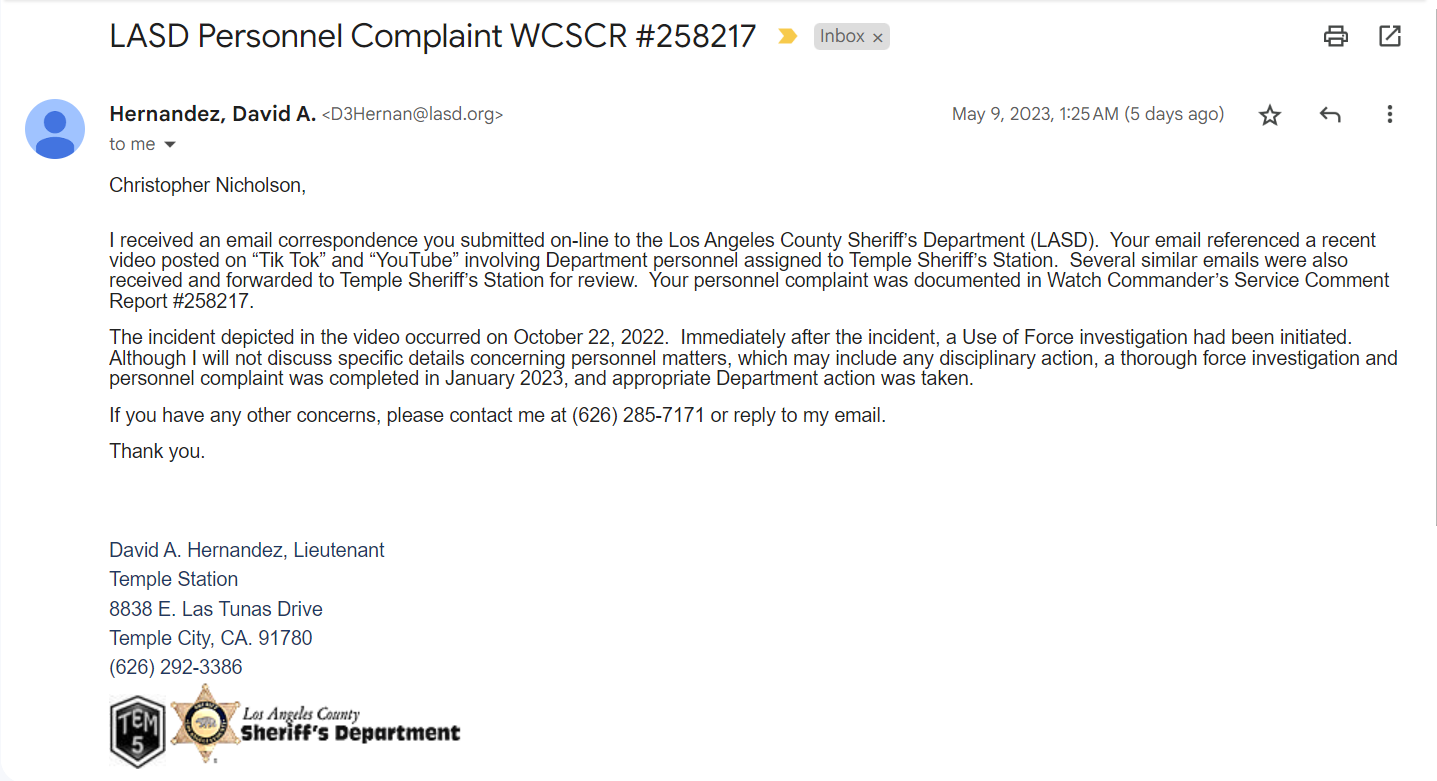 I've started wasting time on Twitter instead of reddit lately. I used to do essentially nothing on Twitter except share my blog posts, and I stayed at 38 followers for over six years. Now after a few weeks of interacting with people, I'm up to 53, so yay. 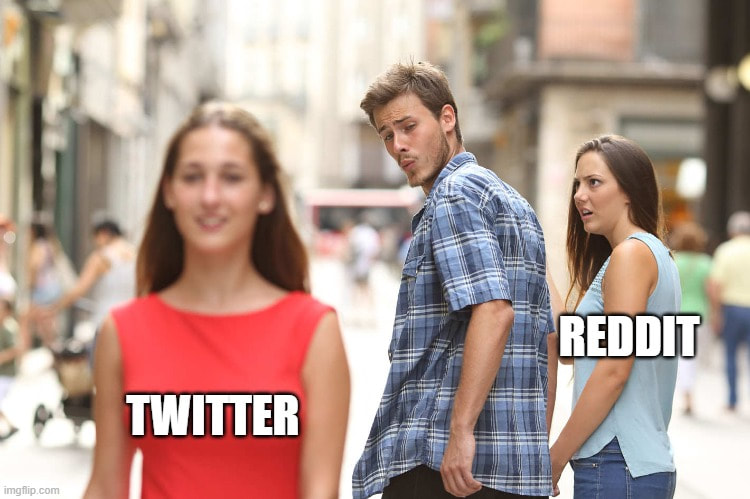 Twitter brings out the worst in people, including me, because it has almost no rules. Before Elon Musk took over, my account was suspended for wishing death on (checks notes) Vladimir Putin. And I still do and I'm not sorry. But now, I can say whatever the hell I want without fear of consequences. I've had some arguments. Even though I only follow ex-Mormons and liberal Mormons as far as Mormon stuff is concerned, I keep getting conservative Mormons in my feed, and they're pretty much the worst people in the world. Half their identity right now revolves around hating transgender people, and the other half is divided between hating apostates, hating liberals, hating scholars, hating gay people, and hating feminists. They're straight-up bullies more often than not, and because they think they're boldly standing up for truth and righteousness, they're quite incapable of attaining any self-awareness about how awful they are. Case in point: 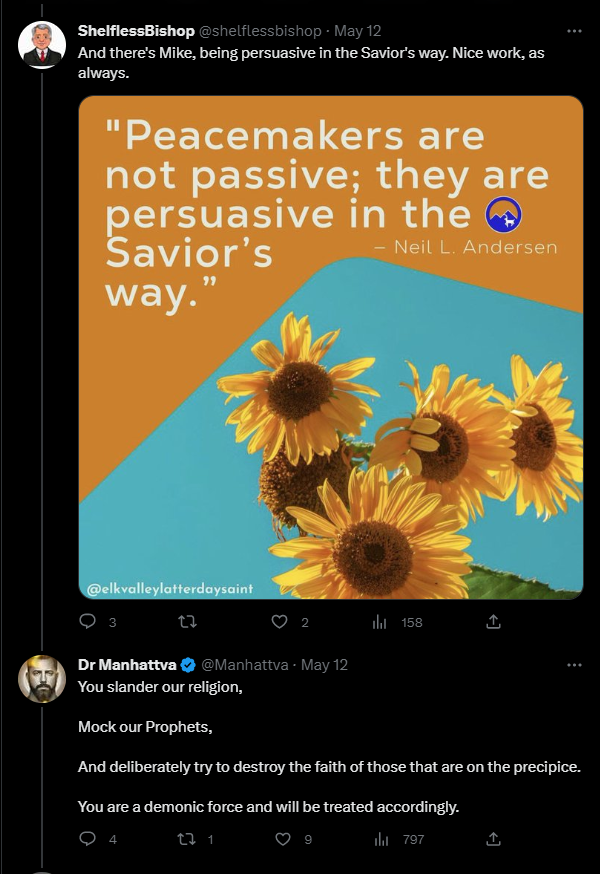 I mean, wow. I used to have a hell of a persecution complex myself, but I don't think there was ever a point when I would have told someone "You are a demonic force and will be treated accordingly." It frightens me that people who think that way exist. Of course, guys like this think I'm a demonic force too. I try to be good. I don't set out to tear down Mormon beliefs every time I see them in my feed. I only get involved if they say something egregiously stupid and/or bigoted. And I try not to mock or insult them until they do it to me first, but that usually doesn't take very long. Personal attacks are usually their first and only response to critique of any kind. They really thought they were clever for pointing out that I had my pronouns in my bio and a Ukrainian flag next to my name. I had to block an account with the word "Christ" in its name that insisted Ukraine "isn't innocent" and basically deserves what it's getting, a claim that could be made with a little more accuracy (though it would still be victim-blaming) about the Mormons who moved into Missouri and boasted that the Lord would give them their neighbors' land. I added a Pride flag and a transgender flag to my Ukrainian flag just to bother these troglodytes, and then I added "If my flags and pronouns bother you, mission accomplished" to my bio to make sure they know that I'm bothering them on purpose, and now they don't bring that stuff up as much.
The leaders of the church don't appear to care that in a few years, people like this will be the only members they have left. Decent, intelligent, empathetic people are being alienated in droves. Of course, some of these jackasses also get alienated every time the church takes a position against bigotry or in favor of modern medicine - the other day one even confessed that he struggles with his faith and desire to attend church because a Primary teacher elsewhere on Twitter wore a rainbow pin - but overall, I think they're winning. Perhaps in fifty years, this church will make the Westboro Baptist Church look like a happy memory. Perhaps it will truly be The Church of Brigham Young, Ezra Taft Benson, and Donald J. Trump. (One of the guys I argued with had modeled his profile after Spencer W. Kimball, though. Kimball's a more nuanced figure in my book. If I meet him in the next life, I'll thank him for what he did to advance racial equality within the church, then kick him between the legs for the vile things he said about women and gay men.) |
"Guys. Chris's blog is the stuff of legends. If you’re ever looking for a good read, check this out!"
- Amelia Whitlock "I don't know how well you know Christopher Randall Nicholson, but... he's trolling. You should read his blog. It's delightful." - David Young 

About the AuthorC. Randall Nicholson is a white cisgender Christian male, so you can hate him without guilt, but he's also autistic and asexual, so you can't, unless you're an anti-vaxxer, in which case the feeling is mutual. This blog is where he periodically rants about life, the universe, and/or everything. Archives
April 2024
Categories
All
|
 RSS Feed
